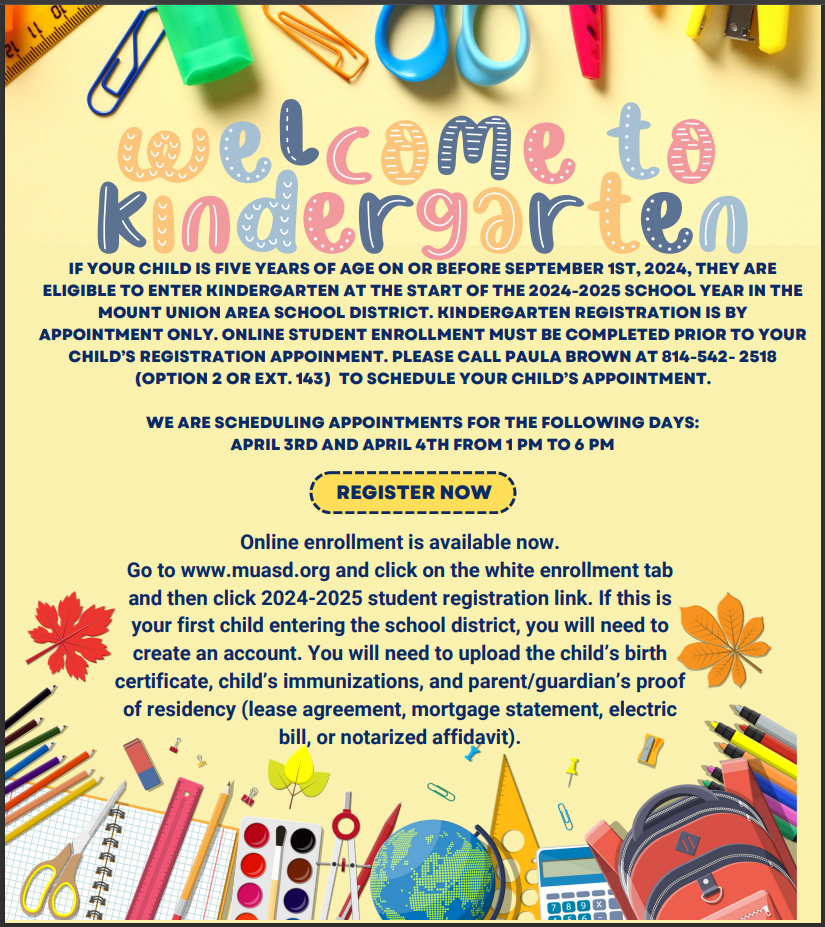
Kindergarten

Department/Grade:  Math/Kindergarten            Course:  Kindergarten Math      Revision Date:  April 2008


Required/Elective:  Required                 Course Length:  1 year  Pre-requisite: None


Course Description: 


COURSE OBJECTIVES

CONTENT OUTLINE

1.  Students will develop an understanding of numbers, number systems and number relationships.


Pennsylvania Academic Standards for Mathematics

2.1.  Numbers, Number Systems and Number Relationships

1.  Count to 100 by 1’s and 10’s

     Count objects to 20 using 1 to 1 correspondence

     Identify and order #’s 0-20

     Use objects to represent groups as well as sets up to 10

     Identify ordinal positions first-fifth

     Identify and write values of pennies, nickels, dimes and quarters

     Count pennies and dimes

     Estimate objects up to 100


2.  Students will apply computation and estimation skills in mathematical operations.


Pennsylvania Academic Standards for Mathematics

2.2.  Computation and Estimation

2.   Estimate a set or number of objects and verify by counting

      Combine two groups of objects and identify sum

      Introduce subtraction using concrete objects


3.  The students will demonstrate an understanding of true and estimated measurements.


Pennsylvania Academic Standards for Mathematics

2.3.  Measurement and Estimation

3.  Understand spatial concept vocabulary

     Estimate and compare length, weight, capacity, time and temperature

     Measure length and height of objects using non-standard units

     Tell and write time to the hour

     Name days of the week and months of the year


4.  The students will communicate their use of mathematical reasoning and problem solving.


Pennsylvania Academic Standards for Mathematics

2.4  Mathematical Reasoning and Connections

2.5  Mathematical Problem Solving and  Communication

4.  Use math comparison terms when discussing the quantity, size, and shape of objects.

     Identify and sort concrete objects according to specified attributes

     Make predictions based on specified attributes of given objects

     Select and use appropriate method, materials, and strategies to solve problems

     Identify the use of measurement in everyday situations


5.  The students will communicate their use of mathematical reasoning and problem solving.


Pennsylvania Academic Standards for Mathematics

2.4  Mathematical Reasoning and Connections

2.5  Mathematical Problem Solving and  Communication

5.  Gather, organize, and display information using charts, graphs, and tallies.

     Form answers and opinions as well as make comparisons and predictions based on data from bar graphs and pictographs

     Predict the likelihood of an event happening using likely, unlikely, or certain

     Compare sets of data using the concepts of largest, smallest, most and least


6.  The students will use algebra and functions.


Pennsylvania Academic Standards for Mathematics

2.8.    Algebra and Functions

6.  Recognize, describe, extend and construct simple patterns found in common objects, sounds, and movements

     Use concrete objects to recreate a simple story problem by trial and error

     Identify the purpose for different mathematical symbols (+, -, and =)

     Explain how solutions are determined

7.       The students will demonstrate knowledge of basic geometric and

Trigonometry concepts.


Pennsylvania Academic Standards for Mathematics

       2.9  Geometry

       2.10 Trigonometry

7.  Identify and name five basic plane figures:  circle, square, triangle, rectangle and oval.

     Identify and create a reflection

     Use plane shapes to construct pictures

     Identify triangles in all environments and discuss how they are alike and different

     Explore symmetry and nature


8.  The students will demonstrate basic concepts of calculus.


Pennsylvania Academic Standards for Mathematics

2.11.  Concepts of Calculus

8.  Order whole numbers (0-20) from least to greatest value

     Identify situations in real life that are slow or fast in happening


RESOURCE MATERIALS

ASSESSMENT

Houghton Mifflin Math Text PB

Classroom  Calendar

Unifix Cubes

Geoboards and Bands

Jewels

Analog Clocks

Pattern Blocks

Concrete Objects for Counting and Sorting

Graphing Mat

Available Computer Software

Big Books:  See K Big Books List

Teacher Made Materials

Measuring Tools

Refer to Standards Booklet


  • Teacher Observation
  • Individual Checklist Assessment based on student demonstration
  • Student written/oral responses
  • Computer Program Evaluations